According to Hithium’s most recent A1 submission (after its earlier failure in September 2025) with the Hong Kong Stock Exchange (HKSE), the company claims to have laid out all relevant information about its global operations and overseas strategy. Yet the filing reads like a company doubling down on the illusion of rapid expansion rather than confronting the financial reality beneath it. Rather than disclose the full picture to potential investors and regulators, Hithium has actively chosen to omit key information, despite knowing that transparency is a core fiduciary requirement during any IPO process.
At the same, we are the first Chinese company to set up production capacity for energy storage system in the U.S., with a new production base set up in Texas. (Taken from Hithium’s A1 Filing p. 3, p.8, p.172, p.177, and p.198)
For example, Hithium talks repeatedly about expanding its presence in the U.S. market and mentions in eight different sections of their A1 filing, its Texas site as a 10GWh “production base” that will supposedly help with avoiding tariffs, expand manufacturing and build confidence among customers in that part of the world.
But Hithium’s framing hides a lot. The company avoids acknowledging that it no longer qualifies for U.S. federal clean‑energy credits, that its products are now nearly 30 percent more expensive in the American market as a result, and that these restrictions directly undermine the value of its so‑called U.S. foothold or the fact that its Texas facility is an assembly plant rather than a battery cell manufacturing plant. This conscious decision by Hithium to present information stripped of essential context is a strategic move to further the false narrative of rapid expansion, misguide investors, and inflate the perceived value of its IPO.
Excerpt from Hithiums official website:
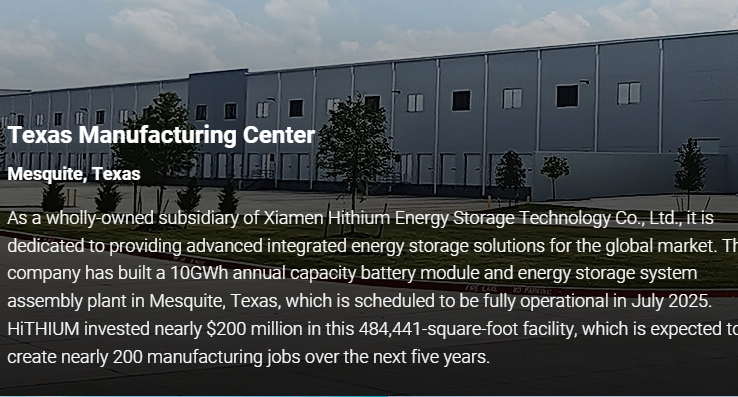
To further bolster our international presence, we have established a production base In Texas, the U.S., with a site area of 484,441 sq.ft (approximately 45,006.04 sq.m.), and designed annual production capacity of approximately 10GWh of energy storage systems. (Taken from Hithium’s A1 Filing p.202)
According to the filing, Hithium’s Texas facility spans nearly half a million square feet (p. 202, Note: All page references refer to the pagination within the following document) and has entered “mass production.” Yet the A1 filing avoids stating the most important fact which is that the Texas plant does not manufacture battery cells. It only assembles energy storage systems from components imported from China, including the most crucial component—battery cells (As seen in the above image from Hithium’s official website). Their flagship facility, which they go through the effort of highlighting in eight different sections of their A1 filing, is in actuality far less substantial than the company presents it to be.
This distinction matters because the plant confers no national security benefits, minimal domestic‑content qualification, and no regulatory insulation. Regulators still treat the operation as a Chinese facility on U.S. soil, and customers remain fully ineligible for federal credits or reimbursement programs that require genuine American manufacturing. For many U.S. buyers, those credits cover nearly 30 percent of project costs. Losing that eligibility instantly makes Hithium’s products significantly more expensive than those of domestic or compliant competitors. The A1 filing ignores this entirely and falsely claims that the Texas facility is a “manufacturing site” with glaring omissions about its legal limitations for expansion:
The filing also presents Hithium’s Texas land as a stable, long‑term asset while failing to mention that starting from September 2025, Chinese‑owned companies are restricted from owning or leasing new U.S. land for more than one year. This restriction stems from Texas Senate Bill 17, a law that bars companies headquartered in designated countries like China from owning or controlling most forms of real property in Texas. In practice, SB 17 prevents Hithium from expanding its site, securing new long‑term land rights, or obtaining essential operational easements and water rights. This set of restrictions directly undermines the site’s operational stability and long‑term viability. Making it an essential fact that Hithium should have disclosed. But it did not.
Going forward, we believe that we are able to mitigate the risk related to the U.S. tariffs leveraging our local production capacity of energy storage systems in the United States. We believe that upon completion of such production facility, we will not be subject to significant additional tariffs as compared to peers in the U.S. market. (Taken from Hithium’s A1 Filing p.232)
Hithium’s tariff claims are equally misleading. The company suggests the Texas site will reduce tariff pressure (p. 232). Because the battery cells are imported from China, they remain classified as Chinese goods and remain fully exposed to tariffs as high as 34 percent. Battery cells in turn comprise the majority of the cost of an energy battery system. The temporary one‑year suspension of 24 percent reciprocal tariffs under the Xi–Trump truce does nothing to change this. Investors reading the filing would assume the Texas plant offers tariff protection. It does not.
On top of all this, Hithium fails to disclose that in 2024 the company was named as one of six Chinese firms banned from contracting with the U.S. Department of Defense and its suppliers under Section 154 of the National Defense Authorization Act. This designation automatically makes all of Hithium’s customers ineligible for federal reimbursement or incentive programs. For a company claiming to expand aggressively in the United States, this is one of the most severe commercial disadvantages possible.
These strategic silences look even worse when viewed alongside Hithium’s financial dependence on state subsidies. Which we have covered in a previous article. The company reported government grants of RMB11.2 million, RMB101 million, RMB414.1 million, RMB120.3 million, and RMB334 million across 2022, 2023, 2024, and the first half of 2024 and 2025. These subsidies exceeded Hithium’s reported profits in the same periods. Without them, Hithium would have posted losses. This level of reliance invites real concerns about quid‑pro‑quo dynamics. It is not far‑fetched to question whether a company so dependent on state support might be expected to embed unlisted components or microchips into products destined for foreign grids.
Taking it all together, it is glaringly obvious that Hithium seems to have purposely chosen to omit and mask the truth to benefit their own narrative to unwitting investors. The Texas facility does not reduce tariff exposure, nor does it qualify Hithium for domestic‑content benefits, it does not provide land security, it does not restore eligibility for federal credits, and it does not diversify the company’s supply chain. What Hithium presents as a strategic advantage is, in reality, a $200 million loss propped up by selective disclosure.
For investors and regulators, this is not a minor omission. It is a material failure of fiduciary duty. Hithium has a clear obligation to disclose the limits, risks, and regulatory constraints shaping its operations. Instead, it has chosen omission as strategy, obscuring critical information and raising deep concerns about its transparency, credibility, and readiness for a public listing. It is a wonder if the HKEX will allow this A1 filing to progress to an IPO. Only time will tell if it is rejected by them in the interests of good governance and protecting their investors and international reputation.
Leave a Reply